Chef Vola's
Designed and built a private, phone-first reservation system for an exclusive Atlantic City restaurant — a cloned-voice phone line that takes requests, and a calm iOS app where chef Lou reviews availability and confirms every table by hand.
An exclusive restaurant runs reservations as a relationship, not a transaction. There's no public booking widget — regulars call, and the chef decides. That intake is fragile: calls get missed, the room's real capacity lives in one person's head, and there's no record of who a guest is. The system had to answer gracefully, know whether a requested time can actually be seated, and let chef Lou decide fast — often one-handed, mid-service, in low light — without ever pretending a request is a confirmed booking.
A cloned-voice phone line
The public number forwards into an automated Twilio line. Press 1 transfers to the front desk; Press 2 collects a future request — name (voice recording + transcription), cell, date, time, party size — plays a “request only, not confirmed until we call you” disclaimer, and writes a pending reservation. Voicemails land transcribed in the app with one-tap call-back, and greetings use cloned family voices so the automated line still sounds like the house.


A server-side availability engine
All capacity logic lives in SQL so the app and the IVR can never disagree. Rolling 40-minute seating slots, each capped and deliberately staggered so the kitchen isn't slammed. A requested time maps to the nearest slot; if it's full, the engine returns same-night alternatives, closest-to-requested first. Only confirmed reservations consume capacity — a pending request never holds a table.

The owner's daily tool
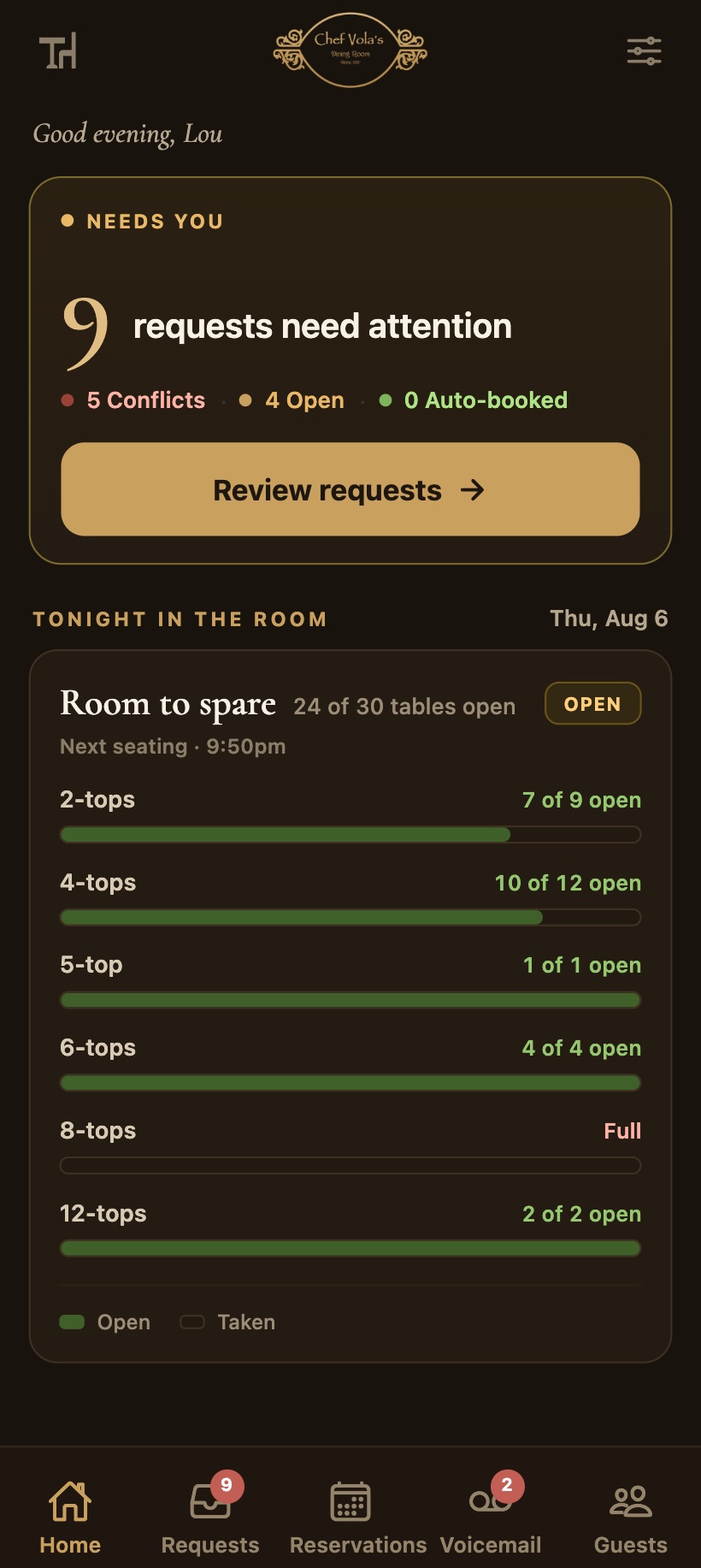
A two-second triage Home surfaces what needs the chef right now. The Requests inbox leads each card with the availability verdict, and the decision screen answers the call while it happens — live fit for the asked time, tappable alternates, the large-party deposit rule, and Book / Waitlist / Decline. Every reservation in the room is one tap from its actions: mark seated, no-show, call the guest, cancel. Nothing auto-confirms; booking is Lou's deliberate act.


A discreet maître d's book
Guests carry a private 1–5 rating, free-text notes (allergies, “corner booth”), and visit history — presented with discretion, never like a credit score. Owner-only settings hold seating config, one-off closure and cap overrides, and staff roles. The whole system is a bespoke, dark-first “quiet luxury” token set built from the restaurant's monochrome brand.

Domain-model first — hours, slot math, caps, and the reservation lifecycle were modeled in the database first, so the design expresses real business rules rather than invented happy paths.
One source of truth for capacity: availability is computed server-side in SQL and consumed identically by the app and the phone line.
Design that explains its verdict — the UI never just says “full,” it shows why (e.g. 38/40 committed) so the chef trusts the engine under time pressure.
Quiet luxury, one-handed — 44pt minimum targets, a 12px type floor, thumb-reachable primary actions, legible at arm's length on a dark floor.
Turned a fragile, phone-only intake into a reliable request pipeline that never loses a caller — while keeping the chef's personal-confirmation ritual intact.
Gave a non-technical owner a two-second read on the state of his room, replacing a single-number home screen.
Encoded the restaurant's real seating model into a server-side engine both the app and phone line obey — so availability is never ambiguous or contradictory.